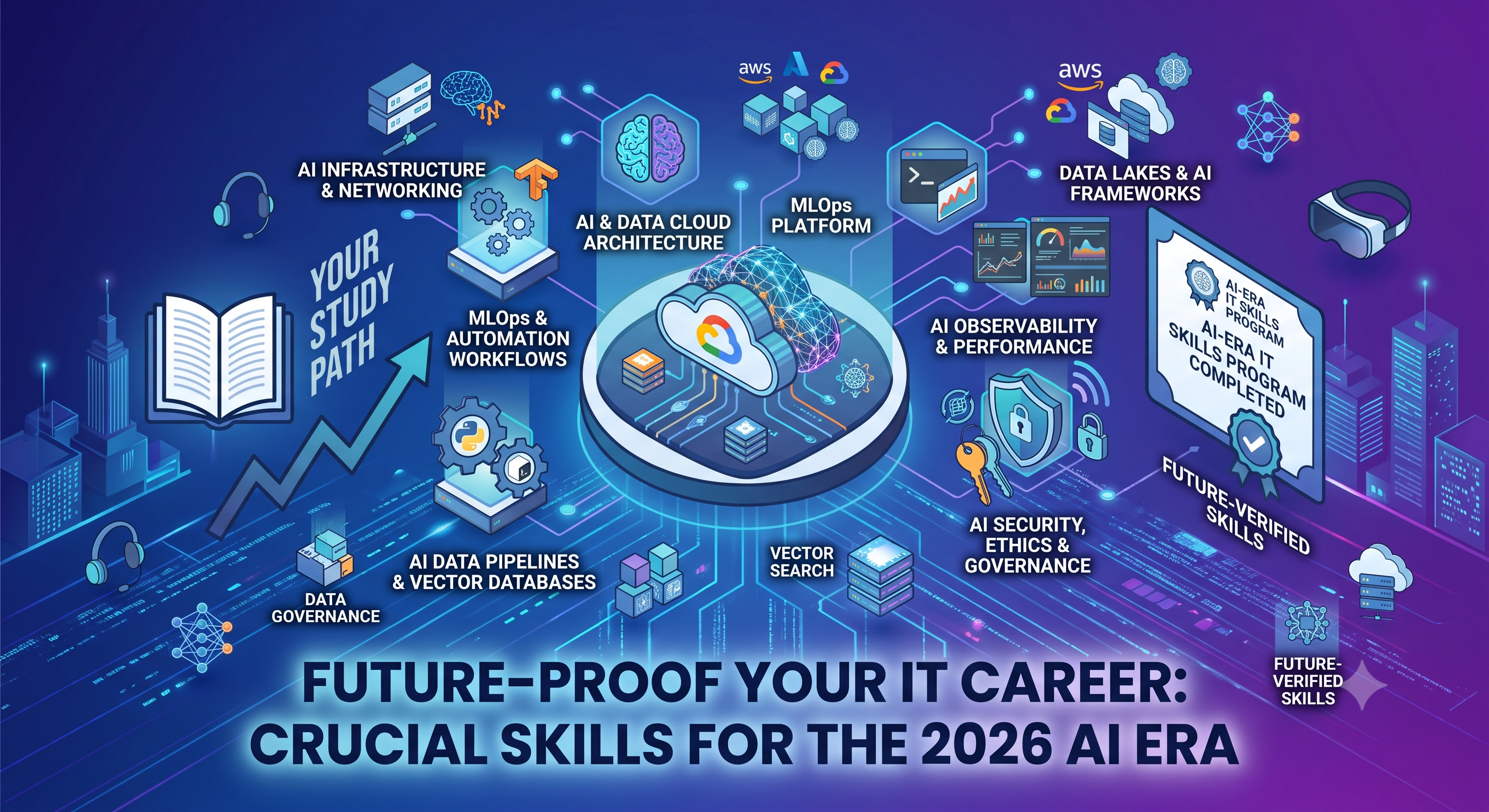
Future-Proof Your IT Career: Crucial Skills for the 2026 AI Era
Sponsored
Future-Proof Your IT Career: Crucial Skills for the 2026 AI Era
The conversation has officially shifted. We are no longer asking, "Will AI take my IT job?" Instead, the question for 2026 is, "How must my IT job evolve to work alongside AI?"
With AI tools handling baseline coding, tier-1 support ticket resolution, and routine infrastructure monitoring, the entry-level IT landscape is transforming. However, the demand for professionals who can build, secure, and fix these highly complex AI integrations is skyrocketing. Here is your guide to staying relevant and highly compensated in the current market.
The Shift to AIOps and Copilots
Gone are the days of manually writing every script or combing through thousands of log lines to find a server error. The integration of AI into IT Operations (AIOps) means your primary job is shifting from "creator of infrastructure" to "editor and auditor of AI-generated infrastructure."
You must become comfortable using AI copilots to generate boilerplate code, write basic PowerShell or Python scripts, and draft YAML manifests. Your real value now lies in knowing how to review that output, identify security flaws or hallucinations, and integrate it safely into production environments.
Core Technical Skills to Master
To remain competitive, you need to bridge the gap between traditional infrastructure and new AI workloads:
Cloud Architecture for AI: AI models require massive compute power. Cloud Engineers who understand how to provision and scale GPU/TPU instances dynamically in AWS, Azure, or GCP are in critical demand.
Data Literacy and Pipelines: AI is useless without clean data. Understanding how data moves through a network, how databases (both SQL and vector databases) are structured, and how to secure data pipelines is a massive advantage.
Prompt Engineering for IT: Knowing how to talk to large language models (LLMs) with precise context, role definitions, and constraints to generate complex IT architectures or troubleshoot obscure system bugs.
Zero-Trust Security: As AI introduces new attack vectors (like prompt injection or automated social engineering), Cybersecurity Analysts who specialize in zero-trust architecture and AI-driven threat detection are seeing massive wage premiums.
The Premium on "Human" Soft Skills
While you are upgrading your technical certifications, do not neglect the skills that machines still cannot replicate. In 2026, tech leaders are hiring heavily based on these human-centric traits:
Critical Thinking: The ability to evaluate an AI system's output for logic, bias, and business alignment. Just because the AI compiled the code doesn't mean it solves the underlying business problem.
Cross-Functional Communication: AI is flattening organizational structures. You will increasingly work directly with marketing, legal, and executive teams to explain how technology impacts their departments.
Complex Problem-Solving: AI is excellent at finding patterns but struggles with novel, unexpected crises. When a multi-region cloud outage occurs due to a cascading failure, human intuition and crisis management are irreplaceable.
Roles Seeing the Highest Growth
If you are looking to pivot or specialize this year, consider aiming your resume toward these rapidly growing hybrid roles:
MLOps Engineer: Bridging DevOps and Machine Learning by managing the deployment, scaling, and monitoring of AI models in production.
AI Security Specialist: Focusing entirely on defending infrastructure against AI-powered cyberattacks and securing internal AI models from data leaks.
Cloud Solutions Architect: Designing hybrid and multi-cloud environments specifically tailored to handle massive, data-heavy generative AI applications.
The IT professionals who thrive in 2026 will not be the ones hiding from automation. They will be the ones who master AI as a tool, combining it with high-level architectural knowledge and irreplaceable human judgment.
Advertisement
This roadmap is exactly what I needed. Quick question: How heavily does the exam focus on hybrid networking configurations compared to last year?
Great question, Alex! The latest iterations have slightly increased the weighting on hybrid connectivity. Make sure you review those architectures thoroughly.