How to Pass the AWS Solutions Architect Exam in 2026
Sponsored
How to Pass the AWS Solutions Architect Associate (SAA-C03) Exam in 2026
The AWS Solutions Architect - Associate certification remains a cornerstone credential for cloud professionals in 2026. This exam, specifically the SAA-C04 version expected to be active, validates your ability to design robust, secure, and cost-effective AWS systems. Here is your definitive step-by-step roadmap for success.
The Roadmap (Visual Overview in Image):
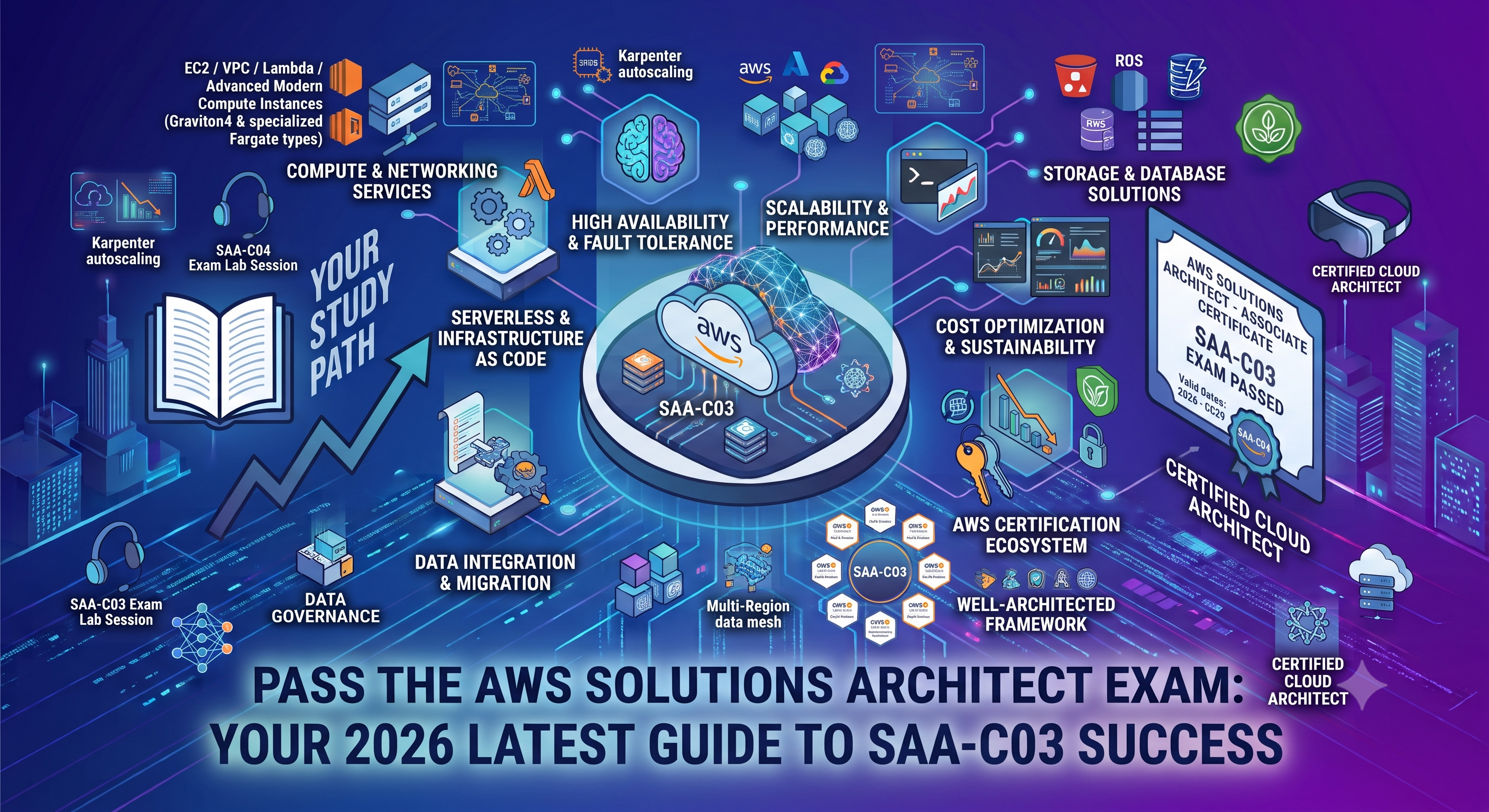
The accompanying image provides an isometric guide to the core domains and study areas you must master. Think of it as your exam preparation battle map, breaking down complex topics into actionable zones.
Left Side (Your Study Path): This represents your initial, structured approach. Start with a comprehensive course to lay the foundation.
Central Clusters (Architecture): This is the core exam focus. You must master designing for high availability, fault tolerance, scalability, and performance in a multi-cloud or hybrid context, always with the AWS logo at the center.
Peripheral Nodes (Specialized Knowledge): Focus on the critical services and architectures: Compute/Networking, Storage/Databases, Serverless/Infrastructure as Code, and Data Integration/Migration.
Right Side (The Goal): This is your ultimate objective: a valid certificate shield and your industry-recognized career credential.
Step-by-Step Guide:
Analyze the SAA-C04 Domain Weights: Study the official AWS exam guide for SAA-C04. Pay close attention to domain weighting (e.g., Design Secure Architectures is often heavily weighted, while Cost Optimization and the new integrated Sustainability pillar are crucial). Look for 2026 specific focus areas.
Select Up-to-Date Study Materials (The Study Path): Don't rely on old resources. Combine a high-quality, 2026-updated video course with official AWS documentation, whitepapers (especially the Well-Architected Framework and all its pillars), and a reputable study guide.
Deep Dive into Core Domains (Peripheral Nodes):
Compute & Networking: Master VPC (subnets, routing, NAT), security groups, EC2, Lambda, and advanced edge services (Route 53, CloudFront).
Storage & Databases: Know S3 (classes, versioning, lifecycles, and especially Instant Retrieval), EBS, EFS, RDS, DynamoDB, and Aurora.
Serverless & IaC: Master Lambda, API Gateway, SQS, SNS, and especially AWS CloudFormation and CDK (essential for modern cloud architects in 2026).
Cost Optimization & Sustainability: This is a vital new domain. Master Cost Explorer, Budgets, and the new specialized tools for calculating and optimizing the environmental impact of your workloads.
Master the AWS Well-Architected Framework: Learn the six pillars inside and out (Security, Cost, Performance, Reliability, Operational Excellence, Sustainability). Apply these principles to every design scenario. (Look for the 'Well-Architected' label in the image).
Get Serious with Hands-On Labs (Data Integration/Pipelines): Theory isn't enough. Build. Set up automated multi-region VPC architectures. Create and deploy a serverless application using CDK. Design a data migration strategy using Kinesis and S3. Use services like DataSync. (See 'Data Integration & Migration' and 'MLOps Pipeline' nodes for visual reference).
Take Multiple Practice Exams (Certificate Prep): Use practice exams specifically designed for SAA-C04 from reputable sources (e.g., Tutorials Dojo, Stephane Maarek). Aim to consistently score 80%+ and analyze every wrong answer.
Exam Day Strategy: Read the questions carefully. Identify keywords. Manage your time. Flag and skip difficult questions. Eliminate incorrect answers. Trust your training.
Leverage Your Certification for Your Next Move (Future Career): Once you pass, update your profile. This associate-level certification is your launchpad. (See the bottom-center node showing how SAA fits into the broader ecosystem of specialized certifications like Professional, Security, and ML).
Advertisement
This roadmap is exactly what I needed. Quick question: How heavily does the exam focus on hybrid networking configurations compared to last year?
Great question, Alex! The latest iterations have slightly increased the weighting on hybrid connectivity. Make sure you review those architectures thoroughly.